
Summary: Four primitive urges—sexuality, food, sleep, and self-preservation—must be consciously regulated. Sexuality should be balanced, neither suppressed nor indulgent. Favor a sattvic diet, regular meals, and mindful eating. Protect consistent, high-quality sleep. Confront fear of death and false identities through reflection to cultivate fearlessness. This article is an excerpt from my book Mastering Pranayama.
There are four primitive urges that must be skillfully regulated. They are:
Sexuality
Food
Sleep
Self-Preservation
Sexuality
Regulating sexuality does not mean you have to lead a life of celibacy. A promiscuous lifestyle can be just as harmful as repressed sexuality. Both excessive indulgence as well as suppression can cause disturbances in the pranic vehicles. Having a deeper relationship based on mutual respect with a partner goes a long way towards maintaining physical as well as mental health and it does not dissipate your energy.
Food and sleep are grosser aspects of the primitive urges since they are required for the immediate maintenance of the body. However, on further contemplation you may realize that the sexual urge is deeply connected to the most powerful of all primitive urges, that of self preservation. The sexual urge has been deeply ingrained in us so that we reproduce, have offsprings and ensure that humanity does not die out. The sexual urge manifests most strongly when the body is mature, healthy and capable of child bearing and child raising. The desire for sexual union is an external manifestation of the natural desire within us to merge with the eternal. Since we are focused outward, it manifests in this external form.
The sexual urge has been highly distorted and is associated with great shame, secrecy and taboo. This is why it is important to see it as just another appetite. Just as we experience hunger for food, we also experience sexual appetite. If we can regulate our food habits through regular intake of meals, why do we find it strange to do the same for the sexual appetite? Sexuality too can be satisfied on a regular basis such as 2-4 times a week with a steady partner. Both partners are mentally as well as physically prepared, taking the time to enjoy each other’s company. In this way sexuality can be transformed from a physical need to respectful and considerate companionship.
Here are some important points to remember:
1. Regulate sexuality with a single intimate partner.
2. Promote a healthy relationship with your partner based on mutual respect and participation in each other’s lives.
3. Maintain regular days and times for sexual union with your partner. This prepares you physically and mentally for the time with your partner.
Food
What we eat has a tremendous effect on our practice. Anything that is not water, is considered to be food. There are 3 kinds of foods: Sattvic, Rajasic and Tamasic. When we speak about diet here, we are talking about diet with respect to yogic practice. Foods that are light and easy to digest are sattvic. Sattvic food promotes and supports yogic practice. Rajasic or tamasic food should be avoided. Rajasic foods give you a lot of energy. Tamasic foods make the body feel heavy and the mind dull. They cause confusion and sloth.
Tamasic foods include frozen foods or processed foods. Foods with artificial coloring, aromas, preservatives and additives are also tamasic. Food that is overcooked, reheated too often, deep fried or kept overnight is considered to be tamasic. Mushrooms and aged cheese are also considered to be tamasic. Breads with yeast are tamasic, therefore flatbreads bread are to be preferred. Red meats such as beef, lamb and pork are also tamasic. White sugar and all sugary drinks and aerated drinks are also tamasic. Alcohol, drugs and all kinds of intoxicants are tamasic.
Rajasic foods stimulate the mind and body. In excess, they cause irritation, aggression, hyperactivity and sleeplessness. Extremely pungent foods are rajasic. Heavy grains like wheat and heavy lentils are also rajasic. Garlic, chillies, onions, black and green tea and coffee are rajasic. White meats such as poultry and fish are rajasic. Eggs too are rajasic.
Sattvic foods are those that purify the body and do not cause toxins to build up in the body. They are freshly cooked and easy to digest. Almost all fruit and vegetables are sattvic. Figs and lemons are especially sattvic. Grains like unpolished rice and oats are sattvic. Buckwheat and Millet is also considered to be sattvic. Mung dal, chickpeas, chana dal as well as mung beans are sattvic. Spices such as fresh ginger, turmeric, coriander, cumin, cardamon, cinnamon, saffron, holy basil (tulsi) are sattvic. Among milk products fresh yogurt and ghee are sattvic. Among sweeteners natural honey and jaggery are sattvic. Among fats and oils, sesame oil and ghee are sattvic. Seeds like sesame, flax are sattvic. Sprouts of different varieties are sattvic.

Healthy fresh plant based diet Photo by Dan Gold, Unsplash
A sattvic diet is one that has a lot of variety and color. Foods of different color provide us with all the nutrition we require. Such as orange papayas, purple blueberries, red beetroots, yellow mangoes.
Milk was considered to be sattvic but the way the industry produces milk today, it is tamasic due to the industrial processes of homogenization, pasteurization, etc. The huge dairies with poor air, light and space conditions for cows causes stress for the cows. Under these conditions the cows cannot give sattvic milk. Organic milk is an option to consider, since the cows live in better conditions. It is an option to consider goat's milk or sheep's milk since these are not as industrialized as cow's milk.
Always use filtered oils, also called Native or Native Virgin oil. Do not use refined and processed oils. Processed and refined oils fall into the category of tamasic foods.
Use rock salt, it contains different trace elements and minerals. Never use refined salt. Refined salt falls into the category of tamasic foods.
Always practice before meals since it is not possible to practice on a full stomach. If you are doing 4 practices a day, do a morning practice before breakfast, afternoon practice before lunch, evening practice before a light and early evening meal and then a fourth practice before going to bed at night. If you should practice after a meal, you need to wait for 2 hours after a light meal and 4 hours after a heavy meal.
Always try to eat at the same time everyday. This prepares the body and mind for the absorption and assimilation of food.
Some people like to torture themselves by fasting. The best kind of fast is the daily fast. The word breakfast comes from “break the fast”. Every night you fast and this daily fast should be around 12 to 14 hours. If you finish dinner at around 8 p.m. that means you can eat breakfast after 8 a.m. next morning, so that the body has the entire night not only to digest the food but also has enough time for deeper cleansing and regeneration. The daily fast is one of the best things that you can do for your health and overall well being. It may happen that you are invited out for dinner or you may eat a heavy meal, in this case it is best to keep a 14 hour fast. Crash diets and extreme fasting is not necessary as long as you keep the daily 12-14 hour fast.
Eat slowly and with awareness. To increase your awareness while eating it might be useful to count the number of times you chew your food. Do not gobble up your food. Absent-minded eating of food while walking, watching TV, surfing the internet, reading books or comics is not healthy. This can lead to overeating, eventually to obesity, diabetics and other health issues. Never overeat. The yogis have a hand rule for food intake. Fill half the stomach with solids, quarter with liquids (not water) and keep a quarter empty.
As far as possible eat freshly cooked and mildly spiced foods. Avoid heavy foods especially in the evening. Have regular meals at fixed times. Eat consciously and as far as possible eat a variety of foods. Those who are busy and travel a lot, need to find flexible and creative solutions, such as carrying healthy home cooked meals or finding a good place to eat fresh and healthy food.
Drink around 2 liters of liquids through the day. This quantity is only a rough indication. You may need more liquids when down with fever or diarrhea, after sports, in summer or even exposure to cold air. Avoid sugary drinks like aerated drinks. Avoid tea and coffee, instead drink herbal teas. Pour hot water over fresh ginger and your ginger herbal tea is ready! You can do the same with peppermint leaves, tulsi or holy basil leaves. You can also make a delicious herbal mix with different spices such as saffron, cardamom, cloves and cinnamon.
A little bit of experimentation with food is required to see how the food impacts you. Most of time you will notice that food is deeply connected with emotions. When sad or disappointed you want to eat comfort foods like chocolate. Food is not just for the nourishment of the body. Most of us are motivated by our sense of taste rather than the stomach. You need to observe how food affects the mind and nourishes it. Often we experience a hunger for food that is determined by the taste and memories. As far as possible eat only when really hungry; do not burden the stomach with more food, if there is no appetite.
Some important points to remember:
1. Drink 1-2 liters of water everyday.
2. Keep a daily 12-14 hour fast at night.
3. Fill half the stomach with food, quarter with liquids other than water, and quarter empty. Never overeat.
4. Do not eat between meals. Have 3-4 meals daily at regular times.
5. Do not keep food overnight. Prepare food daily.
6. Eat slowly and consciously.
7. Avoid coffee, black and green tea. Drink freshly made herbal teas without sugar instead.
8. Eat only when you are hungry.
Sleep
Since we cannot interfere too much with the natural sleep patterns to regulate this primitive urge is all the more difficult.
There are many misguided yoga practitioners who believe that once they practice some sort of asanas or do a little of what they call meditation, they do not need sleep at all or need just a couple of hours of sleep. They force themselves to keep awake. Some drink coffee and energy drinks to fight off sleep. Extreme disturbance of the sleep patterns can cause serious damage to mental and physical health. Interference with the sleep pattern is dangerous.
Good quality sleep means no disturbance during sleep. A sick person generally does not have good quality sleep. Emotional disturbance also means poor quality sleep. Noise and light pollution can also cause disturbances in sleep. Most of us need around 2-3 deep sleep and 5-6 hours dream time. Dreaming less is possible only when the right method of meditation leads to the 7th limb of Dhyana and the meditator has conscious access to the unconscious mind. He brings the unconscious mind forward in to waking consciousness and therefore there is less stuff to deal with in dream state. It is generally not possible to go to deep sleep directly. Through some yogic practices one can learn to go directly to deep sleep however there is a difference between a technique and a state. Practicing the technique does not mean you have reached that state. Sleep deficit leads to poor concentration, depression and anxiety, loss of memory and poor learning ability. It also accelerates aging, impairs judgement and causes accidents. Sleep deprivation has also been connected to increase in appetite eventually resulting in obesity.
It has also been observed that excessive food causes dullness, drowsiness and inevitably sleepiness. Thus, it is clear that the 4 primitive urges are deeply connected to each other and influence each other.
These days it is difficult to maintain regular sleep patterns due to the strong influence of mobile technology and other media such as Internet and television in our daily lives. Most people leading modern lifestyles work long hours and get too little sleep. They build up a huge sleep deficit and try to compensate on weekends. This only leads to irregular sleeping patterns causing mood swings between hyperactivity and sloth. Getting a healthy amount of sleep is important. For most people 7-8 hours of good quality sleep is sufficient except in the case of infants, adolescents, the aging, the sick and pregnant women. These generally need more sleep. If you sleep too long, you might feel heavy, dull and experience sloth. If you sleep too little, you may get irritable, impatient and snappy. As one gets older, one needs less sleep. Those above the age of 40 years may find themselves sleeping less or sleeping lightly. It does not help to force yourself to sleep, this time can be used more creatively.
Day time naps or power naps are useful especially for those who work a lot and are extremely stressed. If it is possible, lie down for 15-20 minutes. This will rest your body and mind. Do not fall asleep. The short rest will make you more creative and fresh for the rest of the day. Do not nap for more than 20 minutes!
It may not be easy but it is important to try to work out a good bedtime ritual that helps you wind down. Go to bed at the same time every evening and wake up at the same time every morning as part of a bedtime ritual. Most people use the time before bedtime for watching television and surfing the internet. The continuous movement of images disturb the mind instead of soothing the mind. It is best not to watch television or surf the internet at least an hour before bedtime. It is also recommended that you put your mobile phone on airplane mode at least an hour before bedtime. Use the time for a bedtime ritual that soothes and calms the mind. Turn off all devices and even better, do not keep any devices such as mobiles or laptops in your bedroom. Clean your teeth, practice meditation, and read a page or two of a book that calms the mind and strengthens positive thoughts.
Avoid drinking coffee or tea including green tea after 2 p.m. since it disturbs the sleeping patterns. You can drink herbal teas, warm fresh lemon drink with honey or just hot water instead. Do not eat a heavy dinner or indulge in after-dinner snacking in the evening.
Here are some points to remember:
Go to bed at the same time everyday.
Wake up at the same time everyday.
Get around 7-8 hours of quality sleep.
Have a dark and quiet room as your bedroom. Air out the room regularly.
Avoid keeping devices in your bedroom.
Do not drink coffee, black or green tea after 2 pm.
Do not eat heavy meals in the evening. Avoid snacking after-dinner.
Self-Preservation
No one wants to talk about the fear of death. You do not even want to think about it. Fear is deep rooted in us. Self-preservation manifests in the fear of growing old, fear of losing the loved ones and worldly objects such as your house and job. This fear is not merely about physical death.
Fear comes from the death of a false self-identity. If you have the self-image of being young and healthy for the rest of your life, this self-image starts falling apart, when you discover your first gray hair. If you want to create a larger than life self-image of your manhood, then you will feel attacked if someone questions your ability to park a car. While the gender battle over the ability to park a car may be amusing, for a strong self-identity this is a serious attack. Such attacks on the self-identity or Ahamkara are experienced exactly like the threat of a physical death. Ahamkara, the self-identity defends itself against attacks.
The death of a self-identity is probably more painful than a natural physical death. A natural death is like falling asleep. Sleep is known as called Sahodara, the little brother or little sister of death. It is possible that you have a physically painful death if you die an unnatural death, such as due to an accident or drowning, but the process of separation itself is not painful.
When very old people die one says, “You do not have to feel sad because they led a very rich and fulfilling life.” However, when someone dies young, one says, “It is tragic, he was so young, he had so much to do.” A long and fulfilling life means you are able to live out your desires, until they go to the unmanifest state, where you rest. We perceive separation from this body and this plane of existence and from our loved one as painful.
You live a busy life and live out many of your desires and samskaras but at some point time the body gets tired. You, Pure Consciousness have associated with the “nashvar” or the perishable. You forget that you have attached yourself to the perishable. You do not remember that you are Pure Consciousness, that you are not going to die, you will come back again and enjoy this all over again, as long as you have the desire. Every time you go through the same process of separation and experience that pain of separation. After innumerable times of experiencing this pain of separation it has become etched deep in your ancient memories. The fear of death or separation is a vasana, a diffuse memory of deep fear mixed with a numb pain. You do not remember all these deaths or separations; you only left with this unknown fear. The fear of death or separation has been learned over innumerable lives and can be unlearned.
When you know that you are eternal, you are Pure Consciousness, through direct experience of your eternal nature, then you know that you are not really dying. Then the fear disappears. You become fearless. Fearlessness means you are no longer attached to this plane of existence, the “nashvar” and you know that you are eternal and imperishable.
This brings us to the question. How to regulate the primitive urge of self-preservation? No doubt this is the most difficult of all the 4 primitive urges to regulate, since we completely suppress the fear.
Approach the primitive fountain of self -preservation with respect. Take up at least one of the following exercises:
1. Make a list all your fears, such as fear of loneliness, fear of aging
2. Make your last will and testament
3. Comtemplate on what you would do with your life if you are going to die in 1 year
4. Everyday do something that gets you out of your comfort zone, like talking to a stranger, asking someone for a favor
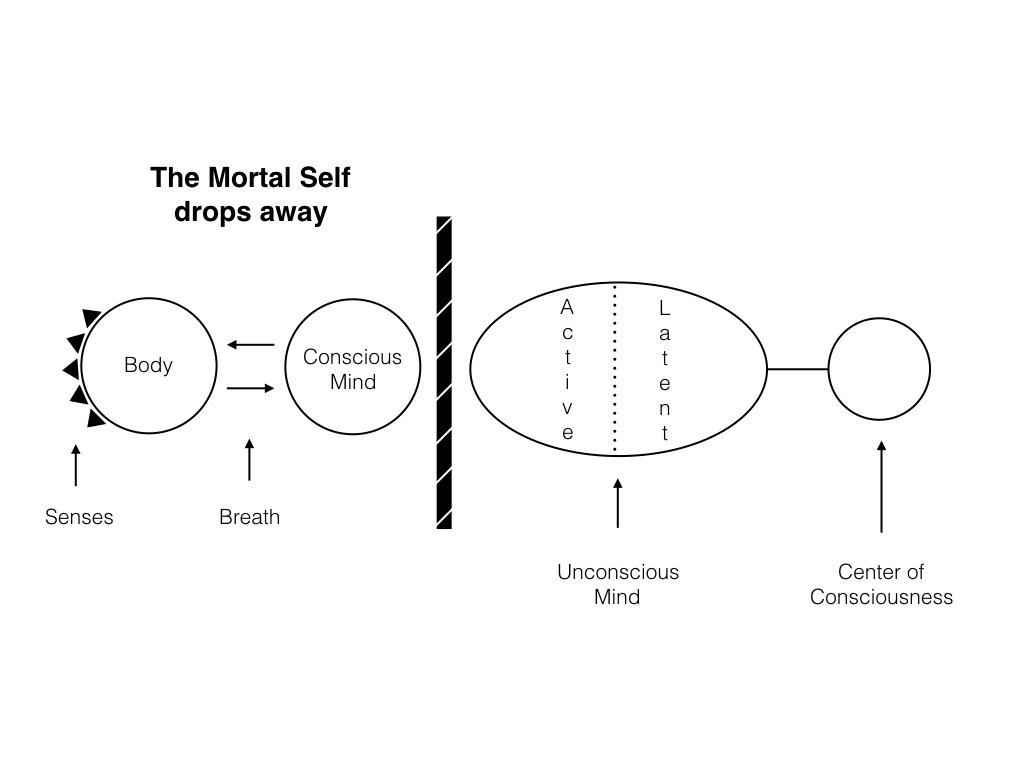
Death is separation Illustration by Radhika Shah Grouven