
Six kinds of evolved beings
This article has been inspired by my book The Yoga Sutras Illuminated (published in May 2025) which details the various evolved beings. They are: mystics, aptas, jivanmuktas, videhamuktas, siddhas,prakritilayas and avatars.
With a profound experience of Samadhi you suddenly become aware of your true nature, which is Individual Consciousness. The first glimpse of Individual Consciousness is a shocking event which can open the locked gates to new worlds.
A mystic is born
A sudden and unexpected separation between mind and Individual Consciousness transforms you into a mystic. You now know you are Individual Conscoiusness, also called the Seer, the Witness or Atman. This is a spontaneous spiritual experience called Samadhi. It is rare but can happen to anyone. This moment of grace is a life changing experience. It turns your life upside down, because everything you thought was important earlier, is no longer of interest to you anymore. Many have had fleeting Samadhis, but they are not intense enough, and are soon forgotten.
In the aftermath of such an intense mystical experience, thoughts, images and emotions, which have not been purified, will come forward and present themselves to be resolved. Fighting against the thoughts, images and emotions takes a lot of energy and creates tension; this approach is not sustainable and the Seer will withdraw behind the veil again. This could potentially explain why artists, poets, and writers, despite having had mystical experiences, are not considered yogis.
A mystic knows through direct perception and she longs to return to her natural state, but she cannot just wait for these moments of grace. It seems that the only option that remains is stabilizing the mind through systematic practice, training the four modifications of the mind, uncoloring the impression of the mind and leading the mind gradually to absorption on a single internal object. This leads to Yoga, union of the Individual Consciousness with Universal Consciousness.
Difference between a mystic and a yogi
Before the lineage of teachers developed, sincere seekers had to rely on mystics who were in direct communion with their own Individual Consciousness and therefore also Universal Consciousness. These mystics had neither the system nor the technology to attain higher states of consciousness at will nor could they guide others to attain these indescribable states of consciousness. Over time the yogic lineages developed the system and the techniques to aid the lay person understand the teachings through direct knowledge. The mystic then had the means to explore the mind and consciousness using a systematic approach. Such a practitioner seeking self-knowledge is a yogi. This is the difference between a mystic and a yogi.
Here one must be mindful of the fact that the word yogi has been trivialized in popular culture by some who focus on physical culture practicing some form of gymnastics they mistakenly call yoga. These practitioners of physical culture call themselves yogis. Therefore it must be clarified that the yogic adepts this article is referring to practice systematically to attain self-knowledge and Self Realization.
While a mystic may or may not be a yogi. A yogic adept is also a mystic.
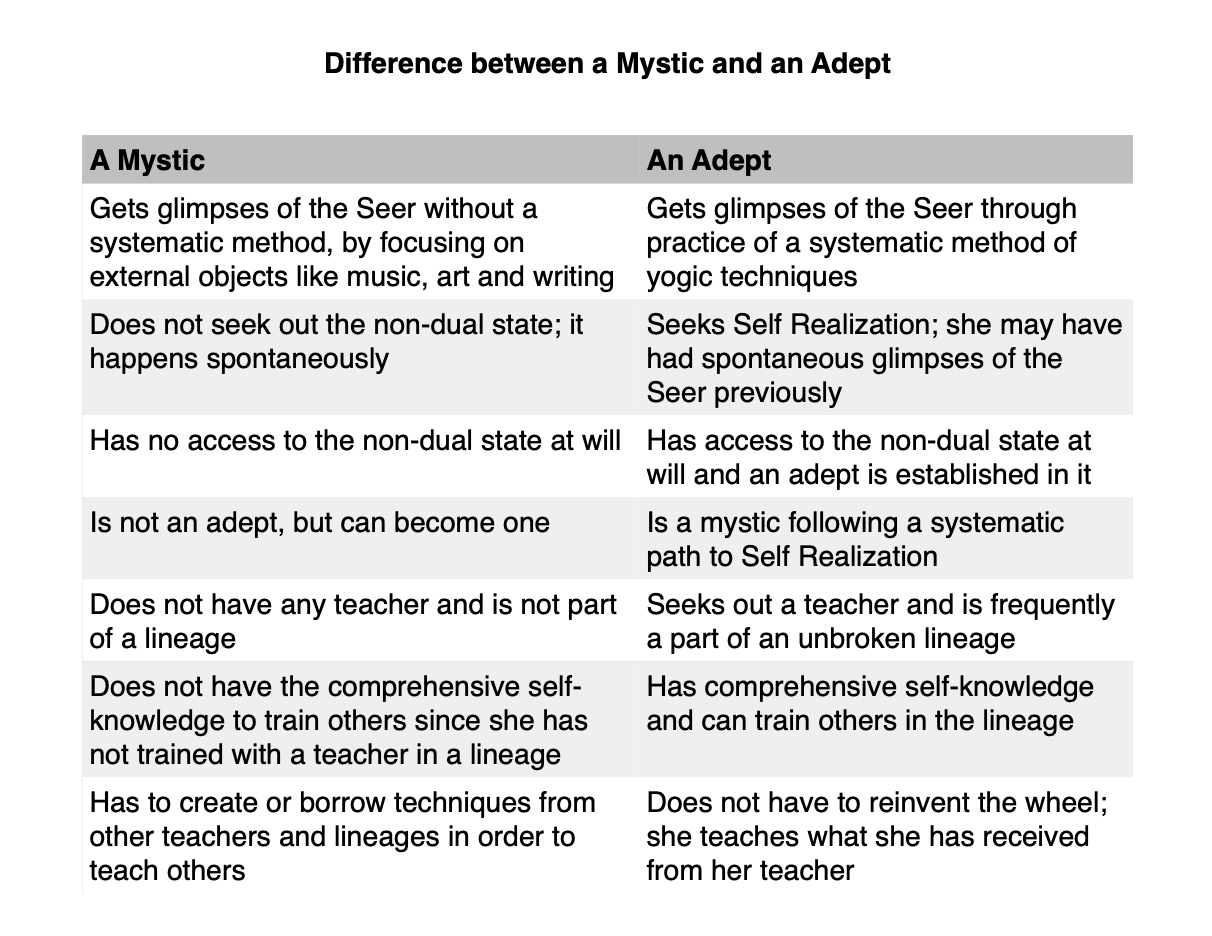
Mystic vs Yogi source: The Yoga Sutras Illuminated by Radhika Shah Grouven
An apta has a one-pointed mind
The one who knows her mind can resolve all the internal conflicts between the four main modifications of mind—manas, buddhi, ahamkara and chitta—until she has a one-pointed mind. The one who has a one-pointed mind is called apta. Whatever the apta says comes to pass. A person displaying such masterful coordination of the mind and senses is known as an apta or arya—“the noble one.” The actions, words and thoughts of the noble one are well coordinated. Such a person can make quick decisions. She is not bound by the sense of identity, which creates limiting conditions. The apta can use all the objects of the world, without becoming attached to them. These objects hold no power over the adept of this high order. The apta perceives them merely as objects, free from attachment or aversion. Her clear self-awareness cuts through all distractions. Quickness of mind is a remarkable attainment, beneficial for everyone, including those longing for Self Realization.
The jivanmukta witnesses
Jivan means “life” and mukta is “the liberated one.” The jivanmukta has brought most of the impressions from the active and latent unconscious into the awareness of the conscious mind. Though latent impressions remain, they have been significantly reduced. A jivanmukta is a being who is liberated while still in the body—living effortlessly in the here and now. This is the acme of attainment.
Try this experiment: Look around you, be aware of the space around you. You are here. Try to maintain this awareness just for a couple of moments. You will find that you can do this quite easily. That was your brief experience of the here and now. Now try to do the same experiment for five minutes. This is very difficult, if not impossible. You will find yourself to be distracted by many thoughts, images and feelings; it is the force of the samskaras pulling you back. It is impossible to be in the here and now just by trying hard. Living effortlessly in the present is only possible after uncoloring a significant amount of samskaras in the active and latent unconscious mind.
The idea of living in the present is very popular among those who practice mindfulness meditation. Though they succeed in observing the conscious mind, they are unable to witness the entire mind field of the conscious and unconscious mind. Simple mindfulness meditation is a good practice for stress management, but it is not the same as living in the here and now. The difference between an observer and a Witness must be understood, at least theoretically. Only one who is firmly established as a Witness can effortlessly remain in the present at all times. Such a being is known as a jivanmukta.
The videhamukta is disembodied but conscious
A jivanmukta can leave her body voluntarily and consciously. This is an act of will. On leaving the body voluntarily and consciously with only a few latent impressions remaining to uncolor, such a jivanmukta becomes a videhamukta. Videha means “without body.” The videha is a disembodied soul. Unlike the ordinary mortal, a videhamukta remains conscious and fully aware even in the bodiless state in the macrocosmic planes of consciousness called lokas. Thus, a videhamukta is a conscious disembodied being.
For a jivanmukta, dying without attainment of Final Liberation may not be a satisfactory outcome of prolonged intense practice. However, if she dies consciously as a Seer by witnessing the separation of the jiva—the active and latent unconscious mind—from the physical body, then she becomes a videhamukta. This means that the jivatman can work out the residual samskaras as a videhamukta in the disembodied state. The videhamukta does not have to be reborn in a body to work out her samskaras. On the other hand, one who dies unconsciously remains unconscious even in the disembodied state—the unconscious jiva cannot uncolor the residual samskaras in a disembodied state. Such a jiva needs a body to live out the remaining samskaras and, therefore, must be reborn.
A videhamukta can continue to uncolor the mind patterns in the bodiless state as a conscious resident of the subtle macrocosmic planes of consciousness called lokas. All others must return to the earthly plane of consciousness to continue to evolve, living out the latent impressions until they become conscious and uncolor them in various levels of Samadhi.
A siddha: on the cusp of Final Liberation
A siddha is the resident of the higher heaven called Svah. Siddha means “the perfect one,” or “the one who has attained.” Just as the videhamukta does not need to return to the physical plane of consciousness called Bhur, the siddha does not need to return to the subtler plane of consciousness called Bhuvah. She only needs to work out extremely subtle samskaras in Svah, the causal plane of consciousness. The siddhas, with their higher level of consciousness, are aware of all their samskaras on the causal plane, whereas videhamuktas do not have this awareness as yet. As videhamuktas work out the samskaras of which they are aware in the subtler planes of consciousness, they have the opportunity to evolve into siddhas.
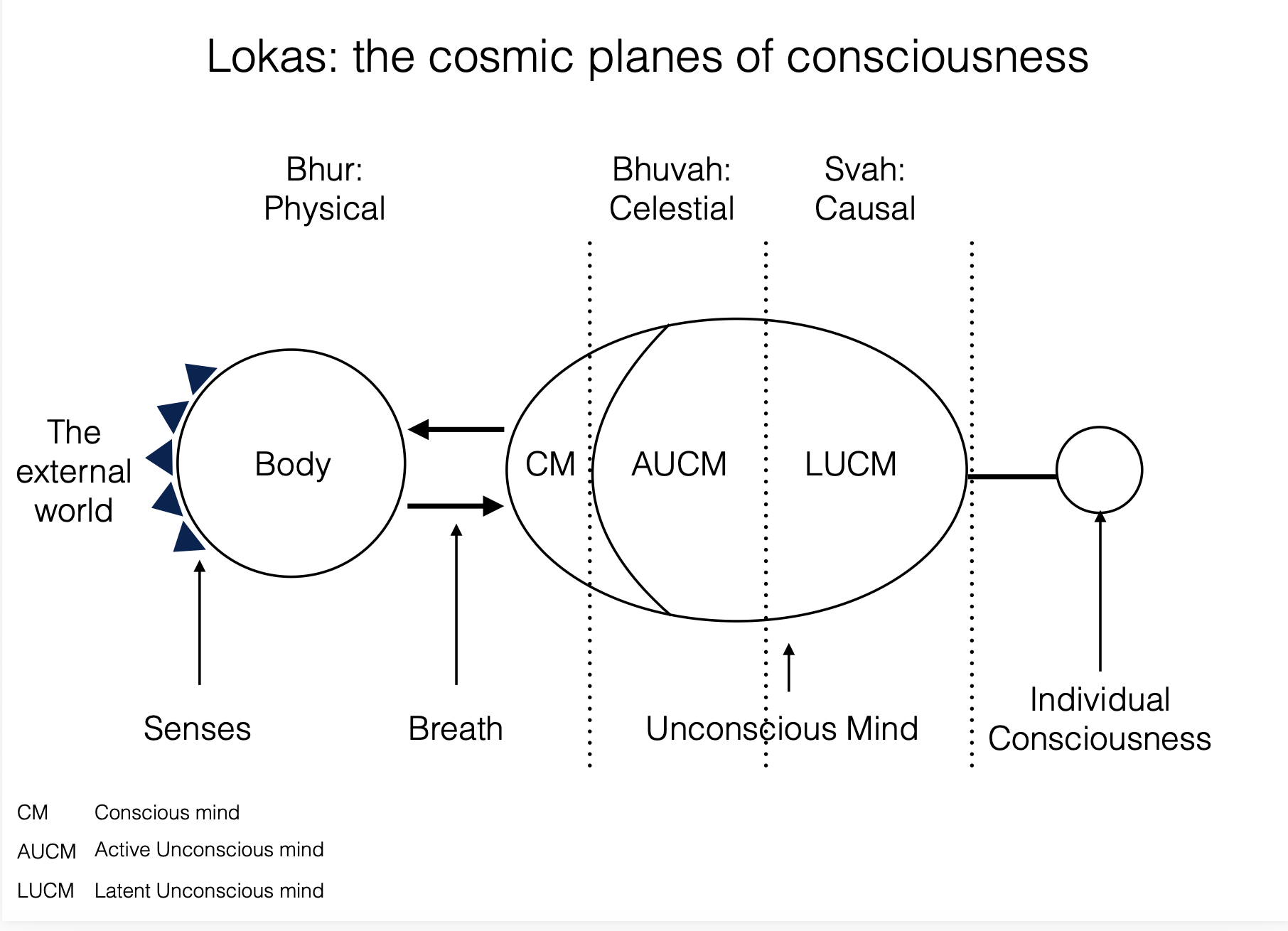
The 3 Lokas source: The Yoga Sutras Illuminated by Radhika Shah Grouven
Videhamuktas and siddhas are highly evolved disembodied beings residing in the macrocosmic plane of consciousness of the active and latent unconscious mind, respectively. Siddhas residing in the causal plane of consciousness are expanding their awareness of the little that remains of the unconscious mind, until there is no more unconscious mind left. They do not need to return to the physical plane of consciousness inhabited by us mortals to live out their samskaras, because they retain their awareness even without a body, which mortals cannot. For all mortals, death and the afterlife remains unconscious.
It must be noted here that the word siddha is also used for practitioners who have gained conscious access to the latent unconscious mind while still inhabiting a human body.
Final Liberation dawns for the prakritilaya
When the Atman is free of the bed of the unconscious mind, the Individual Consciousness is free. This is Kaivalya—Final Liberation. This Individual Consciousness, having the nature of Pure Consciousness, returns to merge with its source Universal Consciousness. This union is Yoga. Once it has merged with the source, this particular free Atman cannot return to guide others. Such liberated souls are called prakritilayas
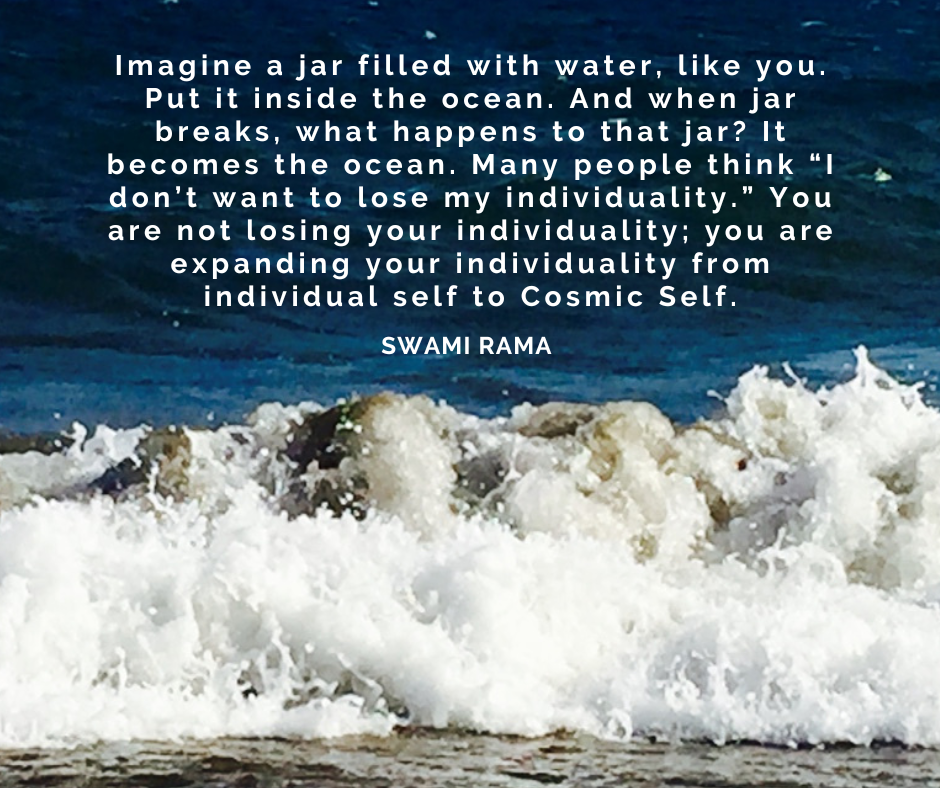
Photo: Radhika Shah Grouven
the Avatar has the privilege of choice
There is another option for the prakritilaya. Rather than plunging into the Ocean of Universal Consciousness and returning to the original state of Pure Consciousness, such a liberated being can choose to take another body of any gender or species, and serve in any of the three lokas. A prakritilaya who chooses to take a body is known as an avatar in Hindu Dharma, an arihant in Jain Dharma, and an arhat in Buddha Dharma. The avatar may choose to serve mortal beings such as ourselves on the physical plane Bhur or evolved beings such as videhamuktas and siddhas on the subtler planes of disembodied beings such as Bhuvah and Svah respectively. This freedom of choice is a privilege of the liberated being, the avatar.
On reading about these evolved beings you may have found yourself surprised—or even unsettled—to realize how arduous the journey you’ve undertaken truly is. Perhaps it spurred you on to reassess your own progress. These great souls too were once mortals like you. Recognizing where you stand is itself a significant step forward.