
AI Summary: This article presents the pranavadins' map of pranic anatomy, which describes five koshas, or layers, surrounding the Center of Consciousness: Annamaya (physical), Pranamaya (energy), Manomaya (mental), Vijnanamaya (awareness), and Anandamaya (bliss). The article then describes three marga, or paths of awareness: Nivritti (inward dissolution toward the source), Pravritti (outward manifestation into body and world), and Purna (the complete path). Mastery means moving between inner stillness and outer life, rejecting neither the subtle realms nor the world. Adapted from my book Mastering Pranayama (2018), available on Amazon.
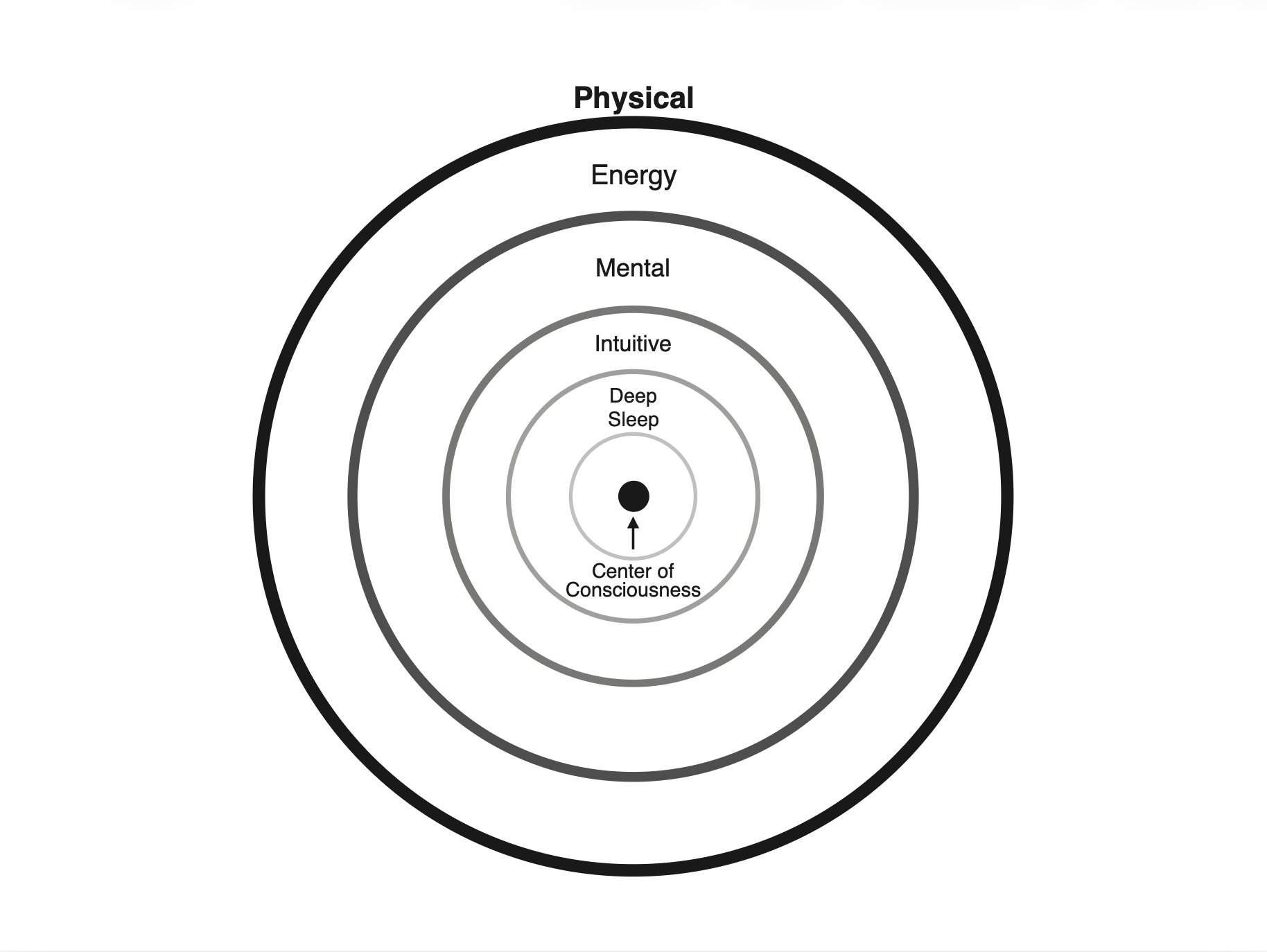
The five koshas
Just as modern medicine has studied the physical body, the pranavadins studied the gross and subtle energies of the body and mapped these. One of the more detailed pranic maps is that of the nadis and the chakras. There is, however, a more general study of the pranic anatomy. This study explains that there are five koshas or “layers.” You are not just body and mind. You are made up of pranic layers.
Annamaya Kosha, the Physical Layer
The first layer is Annamaya Kosha. Anna means “food.” Annamaya means “composed of food” or “filled with food.” While this is a direct reference to the physical body, it includes the world around us. The body itself is just as gross as the worldly objects around us. The entire world is part of this first layer. Materialists remain focused on this layer of the body and worldly objects. Those who practice a style of Yoga based entirely on body culture remain at this first layer.
Contemplation Exercise:
Which aspect of Annamaya kosha creates obstacles for you in your daily practice: the world, food or the body?
Pranamaya Kosha, the Energy Layer
The second layer of the individual is Pranamaya Kosha. Pranamaya means “filled with prana.” This is the layer in which the nadis nourish the body. Just as the physical body has the nervous system, the pranic layer of body has nadis, subtle energy channels that run through the body. These are a subtler form of the nervous system. It’s the difference between electric wiring and the electricity that runs through it. While the nerves can be compared to electric wires, the nadis are the concentrated form of energy moving along pranic pathways. There may be blocks in these energy channels; an important part of the practice is to remove these blocks and allow the energy to flow freely through the body.
Blocks in the energy field may manifest at the physical level in the form of disease. Understanding the koshas helps us to heal ourselves. As one begins the inner journey the practitioner travels from the grosser to the subtler layers of the body and in the process stumbles about blockages. A physical disease treated at a physical level may ameliorate suffering, but it cannot remove the cause of the disease. As long as the root cause, which may well be found at deeper levels, is not dealt with, the disease will keep manifesting in different forms at different levels.
Contemplation Exercise:
While practicing Shavyatra, also known as 61-points, one may experience blockages in the pranic body and learn how to remove these. Have you discovered a block through this practice? Have you managed to remove the block? How did you do it?
Manomaya Kosha, the Mental Layer
The third layer is Manomaya Kosha. The word manomaya means “filled with mind.” This is the layer of the mind. While creative and dynamic people have unconsciously gained access to the tremendous potential of the mind, the practitioner seeks to explore the mind consciously and systematically.
Contemplation Exercise:
Which practice, technique or method—it doesn’t have to be a yogic one—helps you become most aware of your thoughts and mental states?
Vijnanamaya Kosha, the Layer of Wisdom
The fourth layer is Vijnanamaya Kosha. Vijnana means “direct knowledge” or “practical knowledge.” This is the seat of wisdom and awareness known as buddhi. Vijnanamaya Kosha is often translated as intellect. This is an incorrect translation because this kosha is not related merely to reasoning. It is an extremely subtle layer, and therefore difficult to relate to without direct experience. Having access to Vijnanamaya Kosha means the practitioner is conscious and aware therefore he is no longer dependent on external guidance. He is well on his way to becoming an adept.
Contemplation Exercise:
Have you experienced moments of clear awareness and were able to observe your own thoughts? Give an example of how you used this awareness to take a decision.
Anandamaya Kosha, the Layer of Joy and Bliss
The fifth layer is Anandamaya Kosha. Anandamaya means “filled with joy.” You go into deep sleep every night, but you do so unconsciously. If you would experience deep sleep consciously, you would experience absolute bliss or pure joy known as Ananda. The idea of experiencing deep sleep consciously seems paradoxical. How can one be in deep sleep and yet conscious? As you go deeper into the subtler realms you will encounter apparently paradoxical situations where the laws of the external world do not hold.
Contemplation Exercise:
Have you ever experienced reasonless joy? Can you recall the circumstances around it? How did it transform you?
Adi Prana and the Center of Consciousness
The koshas are connected to the Center of Consciousness by Adi Prana. This is no longer just the nadis but the source of all energy. To use the example of electricity, this is not just the electric wiring in the house, but the main cable carrying the electricity from a nuclear reactor to a city. The Center of Consciousness is like the nuclear reactor, which is the source of all energy.
To use another simile: these koshas are like the waves in the Ocean of Prana, that is why they are generally visualized as ripples around a drop. There are five rings around a dot of Pure Consciousness. The outmost ring is the Annamaya Kosha. The innermost ring, the Anandamaya Kosha, is called Deep Sleep. The drop is the Center of Consciousness, the source of all energy or prana.
Piercing the Five Layers
The study of the margas is an important aspect of the science of pranayama. Marga means “path.” Awareness takes three paths. These were studied and well-documented by the pranavadins. To master pranayama the practitioner must observe and analyze all the three paths.
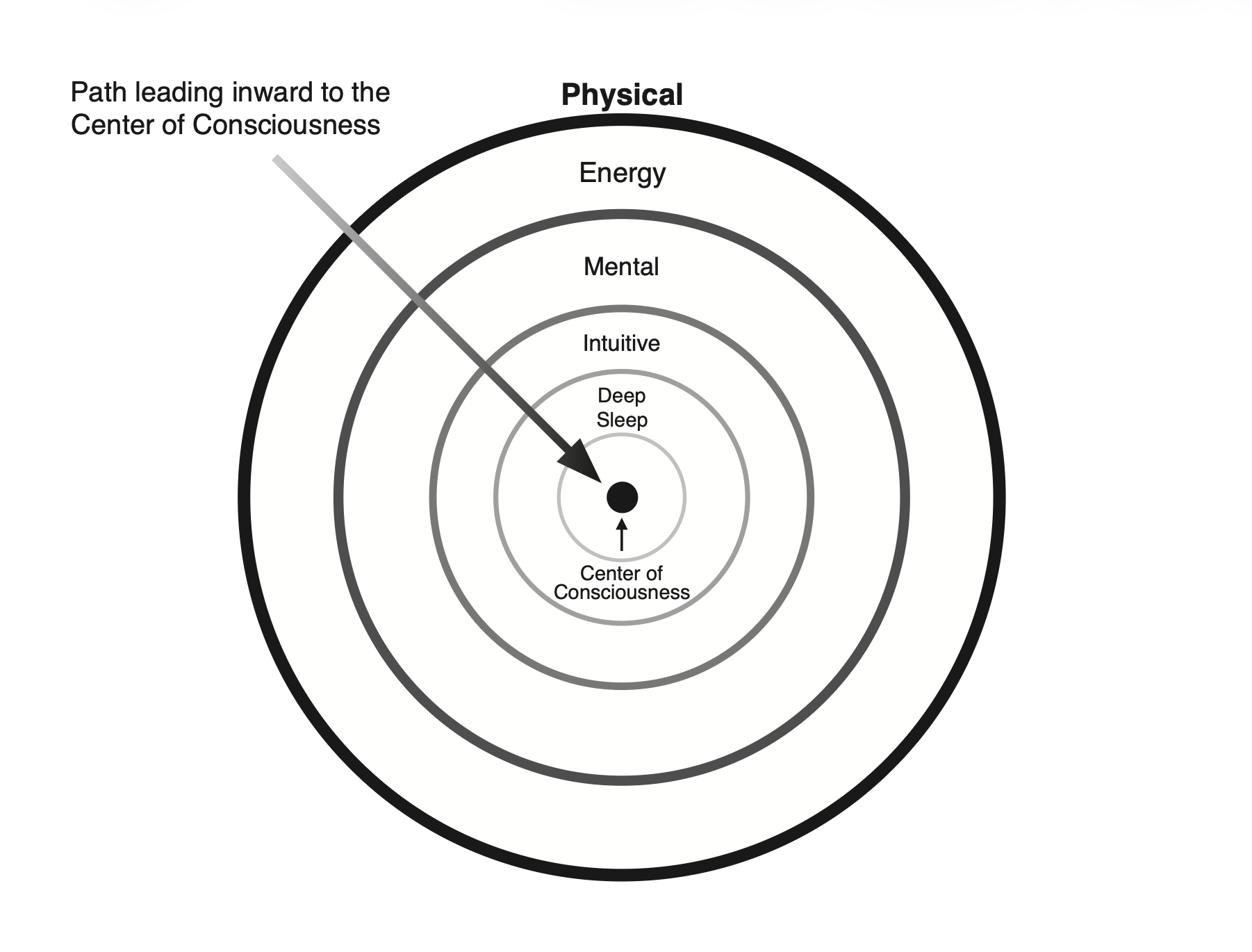
Nivritti Marga
Nivritti Marga -Dissolution
Nivritti Marga is when the awareness turns inward from the external world to the body, moving towards the mind and eventually to the source of all prana. Nivritti means “cessation,” “returning,” or “dissolution.” This internal journey leads away from the many worldly objects toward self-knowledge.
The process of moving from the gross to the subtle is known as Nivritti Marga. Through systematic practice, you allow your attention to move from the body to the layer of energy, go deeper into the mind and get in touch with your inner wisdom. Eventually, systematic practice will lead you to the Anandamaya Kosha, the deepest sheath of pure joy and bliss.
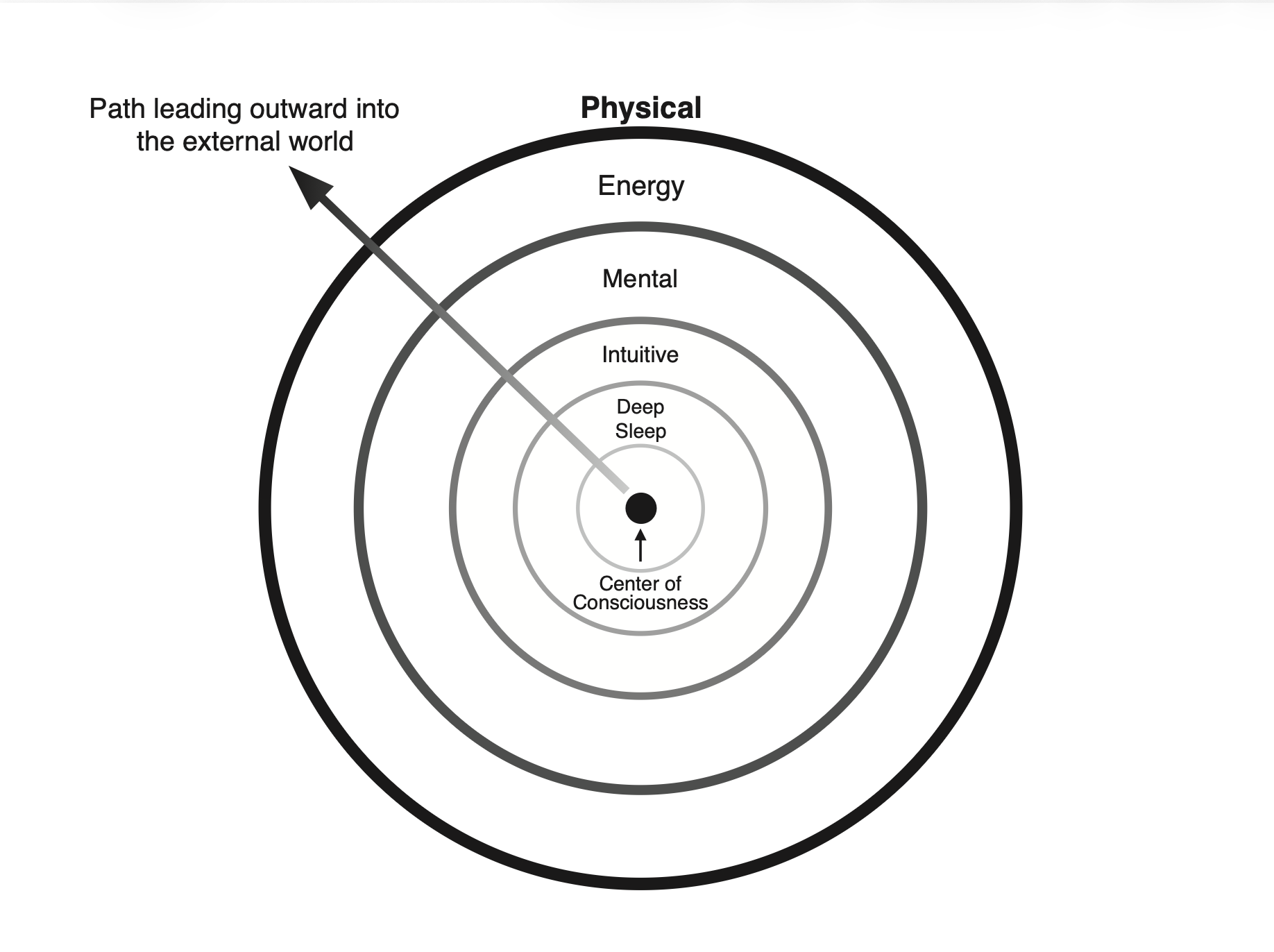
Pravritti Marg
Pravritti Marga- Manifestation
The shifting of the awareness from the subtle-most towards the body and the worldly objects is known as Pravritti Marga. Pravritti means “coming forth” or “manifestation.” This is the understanding of manifestation in the yogic tradition, unlike the meaning attributed to it by modern life coaches who focus only on desire fulfillment.
The koshas are nothing other than waves of energy, which create the body and the world. They emerge from a drop of Pure Consciousness and expand outward like a ripple. This is how consciousness radiates outward, manifesting the body and the world. Pravritti Marga is the path of evolution and it happens naturally and effortlessly, while Nivritti marga, the path of dissolution, requires effort and practice. Materialists emphasize on the outward moving path, while spiritualists emphasize on the inward moving path. In reality both the paths are incomplete.
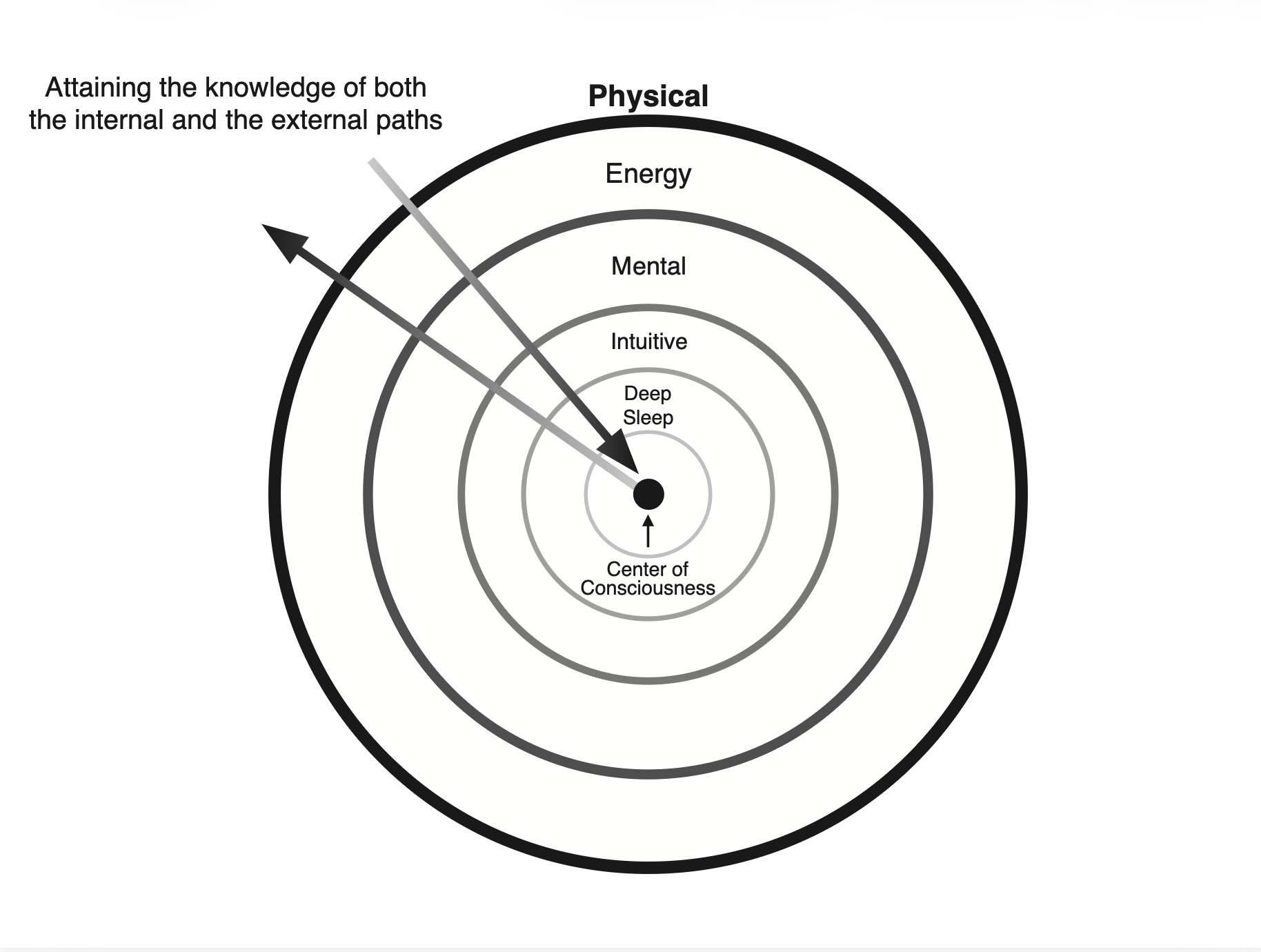
Purna Marg
Purna Marga-The Complete Path
The laws of the internal and the external world are different. When we understand these laws and live in harmony with both, then we are masters of both, the internal and external paths. This is called Purna Marga. Purna means “complete.”
Mastery is attained when you can do both—systematically go inward as well as return to the external world. You neither reject the world as many spiritualists and religionists do, nor do you reject the subtler realms as many materialists and scientists do.
You must learn to master both Nivritti Marga as well as Pravritti Marga.
The disturbing formation of new layer
According to Advaita the five sheaths are illusory, and the tantrik views them as manifestations of the true Self. Indeed, we have manifested a new layer, which I call, the Cybermayakosha. Many of us, in particular the younger generation that does not know of a world without the Cybermayakosha, have a hard time relating to the Annamayakosha, which itself blinds us to the deeper reality of our true nature, the Center of Consciousness.
As we live in the Cybermayakosha of social media creating illusions of friends, followers and influencers, we go further away from the inner worlds of self-knowledge. The farther we go outward the less connected we feel to ourselves and the more miserable we become.
Contemplation Exercise:
What is your experience with the almost addictive nature of social media and what are some of the methods you use to deal with it?