
Time, Goal or Purpose — What's Your Life Orientation?
Summary: There are three kinds of travelers in the journey of life. The time-oriented drift without direction, pulled between the past and the future. The goal-oriented are fewer in number. They are disciplined, productive, capable of genuine achievement, yet remain bound to outcomes that satisfy only briefly for the next goal already looms ahead. The purpose-oriented are rarer still. In them, thought, speech, and action flow naturally and spontaneously. They seek answers to profound questions. Whatever name you give to that higher purpose — moksha, wholeness, divinity — the orientation is the same: a life in which challenges are embraced as part of the journey. This article has been inspired by the teachings of Swami Rama.
In the year 1980 Swami Rama published a short article in the Journal of Holistic Health in which he briefly mentioned the three categories of people passing through life. Since I read the article over two decades ago, this short paragraph has stuck with me. I have often contemplated on these three categories and found them to be a useful measure of self-study. And now, 25 years later I have finally put down some of those thoughts together in this blog post.
The three categories of people traveling through the procession of life are: those who are time-oriented, goal-oriented or purpose-oriented.
The time-oriented
The first category of people are constantly moving in the world without understanding why; they have no vision of the future. They spend most of their lives fantasizing about their idyllic future or analyzing triumphs or defeats from the past, failing to appreciate things the way they are. The time-oriented person is not necessarily lazy or unintelligent — in fact they are generally incredibly busy and ambitious. However, their energy is reactive rather than focused and directed. They are tossed around by the stormy currents of life. This is observed in the life of a person who spends decades replaying an unpleasant incident from childhood, allowing it to color every relationship and opportunity that follows. Another common instance of a time-oriented behavior pattern can be noticed in someone who perpetually postpones happiness waiting for the next relationship, the next job or a change of circumstances — only to find that it was as illusive as a mirage. Their inner life oscillates between nostalgia and fantasy, and the present moment, the only moment in which life is actually experienced, remains largely unappreciated. They are thus forever dissatisfied. Like a traveler who stares only at the map of where he have been or dream of where he might visit one day, they miss the terrain beneath their feet entirely. For such people, staying healthy and finding success is difficult, not because they lack the capacity, but because health and success both require sustained attention they have never cultivated.
Contemplation exercise:
Sit quietly and recall how much of your time and mental energy was spent unconsciously replaying past events or projecting into an imagined future in the last few hours? Ask yourself how you can change this?
Do you think contemplating past experiences and future possibilities is of some value? How is it useful?
Who makes time-oriented decisions— is it manas, buddhi, ahamkara or chitta?
The Goal-oriented
The second category of people are those who can physically and mentally discipline themselves to a certain extent. They understand that a desired outcome requires effort and that effort in turn requires focused attention. They set targets, build habits, and take satisfaction in measurable achievement. Their goals are confined to worldly attainments such as a house, a partner, a job, recognition, a car and other comforts. The entrepreneur who builds a successful company, the athlete who trains methodically toward a championship or the ambitious executive who climbs deliberately through the ranks of a corporate career are clear examples of goal orientation. They conduct their duties with admirable efficiency, self-restraint and focus. Yet their vision remains limited by the nature of goals themselves: goals have endpoints. Once reached, they offer a brief satisfaction before the mind shifts restlessly to the next unfulfilled desire. The runner who dedicates years to qualifying for a major marathon sometimes finds, upon crossing the finish line, not fulfillment but a strange emptiness now that the intense energy required to reach the goal has been spent. They think that these things will satisfy them and fulfill the purpose of life, but after attaining them, they feel lost because they do not know why they had sought them in the first place.
For a lack of higher purpose, their lives remain oriented toward material goals—toward outcomes that can be measured, possessed, and often displayed. This goal orientation is recognized by our modern approach to life as achievement and commands respect and higher status. This has the unfortunate result that this goal-oriented behavior pattern is further strengthened and repeated.
Contemplation exercise:
Choose one goal you are currently working toward and ask yourself how you’ll feel once this is achieved?
Reflect on the phases in your life when you might have been time- or goal-oriented.
What are the goals you want to accomplish in the next one year? Have you a plan to achieve these and why are they so important to you?
Observe your mind during contemplation and ask, “Who or which aspect of antahkarana—manas, buddhi, ahamkara or chitta— has goals?”

Goal-oriented approach to life Photo: Tom Briskey, Unsplash
The Purpose-oriented
The third category is composed of those few who are purpose-oriented. Whatever they think, speak, and do is in accordance with a higher purpose in life. This consistency is not achieved through rigid self-control— it arises naturally from a deep understanding of their life purpose. Their daily choices and commitments are measured against this clarity of purpose which in turn reflects in their daily lives. Consider a physician, who doesn’t merely practice medicine as a means of living but who sees healing as a noble calling—he adopts the stance of selfless service as he listens and treats the person before him, not just as another case to be managed, but as a human being whose suffering matters. Or consider a cook in a school canteen or religious organization who recognizes that feeding her guests is a form of worship. She would never serve them stale food or buy poor quality ingredients.
The purpose-oriented regulate their habits, not out of compulsion, but because they understand that the body and mind must be taken care of to remain healthy and live out the samskaras that brought them to this plane. The body that is neglected becomes a source of disease and distress and the mind that is uncultivated becomes distracted or dull. For them, maintaining good physical and mental health means preserving the only instruments they have to carry out the purpose of life to completion — the way a musician tends a beloved instrument not from obligation but for the love of music.
What label one attaches to this purpose — holistic health, a state of tranquility, moksha, samadhi, divinity, Self-realization — is immaterial. The names arise from different traditions and languages but point toward a life in which the outer and the inner are no longer in conflict, in which thought, speech and action flows harmoniously. Such people are rare, but they are architects of their own lives, not because they have been spared suffering, but because challenges are understood as part of the journey rather than events that derail it.
The purpose-oriented are, in the deepest sense, at home in the procession of life.
Contemplation exercise:
Would you assess yourself as predominantly time-oriented, goal-oriented or purpose-oriented?
As you contemplate, observe your mind and inquire: “Which aspect of antahkarana seeks self-knowledge?”
If you assess yourself as purpose-oriented, ask yourself if your decisions and actions are aligned with this purpose? Is your life moving in this chosen direction? If not, how can you correct your course?
Are you keeping the right company (satsang) that strengthens your life purpose?
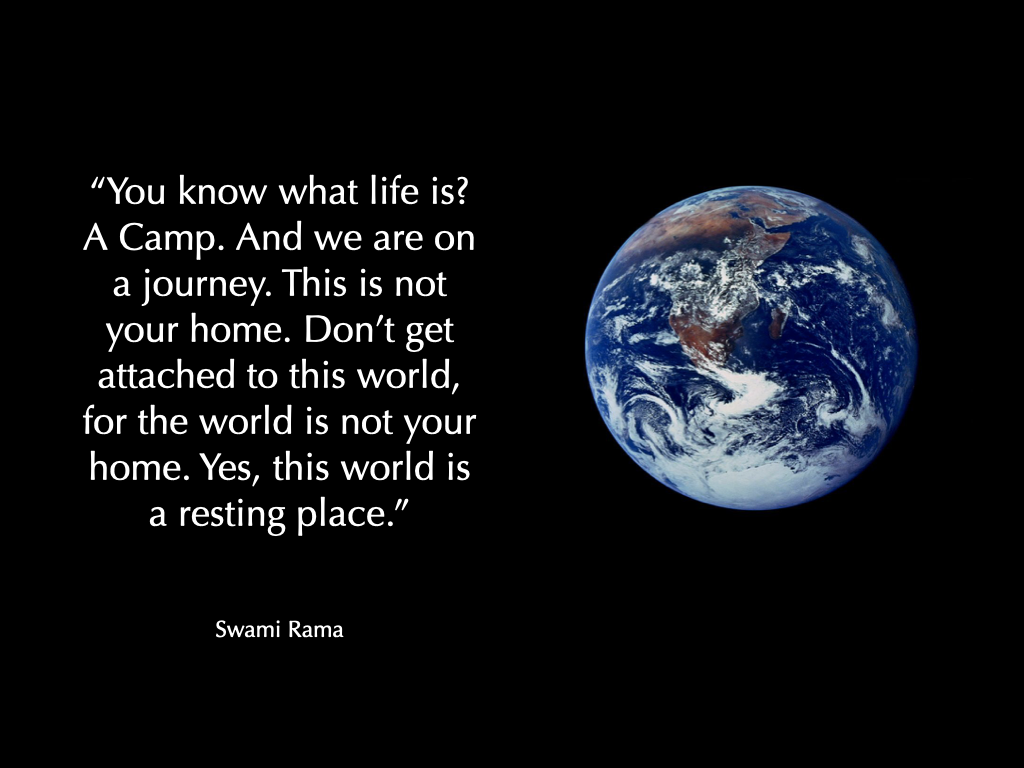
A different approach to life and living Photo: NASA
Transformation to purpose-orientation
Most people are time- or goal-oriented. Only the rare few may have the samskaras from a previous life leading them in the direction of purpose orientation. For all others this transformative journey is rough. There are three incidences that could possibly motivate these people to become purposeful in life:
Generally, disease and accidents and the distress arising out of these causes a rude awakening, forcing the few who then feel the urgent need to change to examine their lives. A near-death-experience (NDE) is a particularly intense experience that could awaken a person, irrespective of other personal circumstances.
A personal tragedy due to the loss of a dear one in the form of death, breakup or divorce is another strong motivating factor.
Repeated failure as well as the experience of scarcity and lack may also lead to an inquiry in the nature of life, suffering and the meaning of life.
This transformation begins with questions such as:
Who am I?
What is the purpose of my life?
What is the nature of the world?
From where have I come?
Where will I go?”
These are inborn questions common to every human being. Everyone has to face this inquiry sooner or later. Without answers to these fundamental questions of life, mere physical health and mental soundness will not fulfill the purpose of life. An emptiness, avoid, and a feeling of dissatisfaction will remain. While the experiences of the world (bhoga) lead us toward inquiry gradually through innumerable lifetimes, intense experiences or trauma can expedite that process. Under these circumstances evolution of consciousness that would take many lifetimes to bring about this inquiry, becomes a matter of urgency in the current one.
The vicissitudes of life can force insights and transformations but on the other hand soul-crushing suffering can have a negative impact. Instead of leading the person toward a spirit of inquiry intense suffering could induce a kind of impotency making the person a victim of fate and circumstances.
While most people remain time- or goal-oriented all their lives, everyone, including purpose-oriented people, may have phases of both these approaches, partially out of habit and partially out of choice.
Contemplation exercise:
In this blog post I have suggested that the name attached to one's deepest purpose—divinity, moksha, Self-realization—is immaterial. While this is true, giving it a name could clear the mind and help it focus. If you currently identify as a purpose-oriented person, how would you name your purpose?
Understanding and contemplation on the four purusharthas is an extremely useful exercise for cultivation of self-knowledge.
If you don’t have a clear sense of purpose, what are you willing to sacrifice to acquire a meaningful purpose?