
How to sit in meditation Part 1/2
AI Summary: This article is an excerpt from my book Mastering Pranayama, published in 2018. A stable, comfortable seated posture is the foundation of any serious meditation practice. This post outlines the five essential criteria for a correct meditative seat—spinal alignment, a firm triangular base, assimilated limbs, interlocked feet, and Jnana Mudra—drawing on the Bhagavad Gita’s guidance on keeping the trunk, head, and neck in one straight line. You’ll also find practical advice on building a proper meditation seat using natural fabrics like wool and silk, and an honest assessment of three postures: Maitri Asana (seated on a chair), Vajrasana (Thunderbolt), and Sukhasana (Easy Pose), including the limitations of each and how to use layers of shawls as a transitional support rather than a permanent crutch.
Five Important Criteria for a Seated Posture
There are five important criteria for the ideal seated posture:
5 criteria for the right meditation posture Credit: Mastering Pranayama by Radhika Shah Grouven
Head-Neck-Trunk aligned: The most important criteria for a meditative pose is that the back, head and neck are aligned. The ancient Yoga handbook the Bhagavad Gita (VI.13) says: Samam kayashirahgrivam, that is, “keeping your trunk, head and neck aligned.” Kaya means “body,” shirah means “head” and grivam means “neck.” The head, neck and trunk should be straight and perpendicular to the ground or floor. This is very important, irrespective of the posture you sit in. This criterion needs to be observed in all the seated postures.
Firm Triangular Base: When the knees and hips form a firm base that is triangular in shape, the body weight is well distributed, and the knees and ankles do not hurt. The stable base also ensures that the upper torso does not sway.
Legs and Arms assimilated: In the seated posture one tries to keep the extremities as close to the body as possible.
Feet interlocked: Interlocking the legs and feet together ensures compactness of the body and prevents you from jumping up and out of meditation.
Jnana Mudra: Jnana means “knowledge.” Mudra means both “a seal” or “closing.” Jnana Mudra is the seal of knowledge. Mudras have a subtle but powerful influence on our minds. In Jnana Mudra the thumb and index finger touch each other in what is known as the pincer grip position. The pincer grip indicates fine motor abilities that are a major factor in human development. When you sit applying Jnana Mudra, the palms should rest on the knees with fingers pointing downward. If you keep your palms open and your fingers pointing upward, they will always be against gravity. When you keep them pointing downward, they are completely relaxed. This is possible in all seated postures.
Maitri Asana: The Friendship Pose
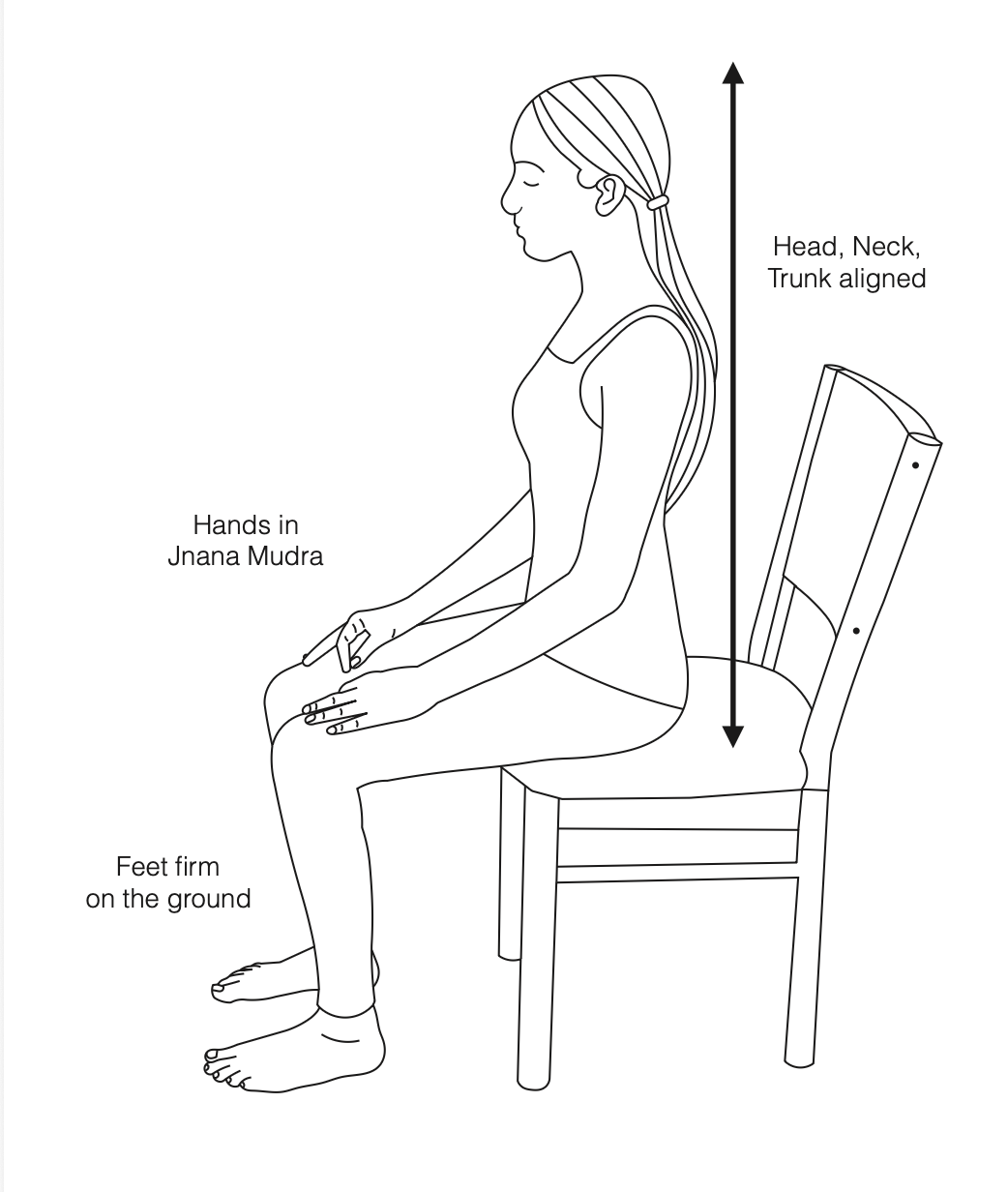
Maitri Asana, the Friendship Pose Credit: Mastering Pranayama by Radhika Shah Grouven
Maitri Asana or the Friendship Pose is a good pose for those, who are not flexible enough to sit on the floor, for those who are overweight, for those with arthritic problems or for those having physical problems such as injuries, which prevent them from sitting in a cross-legged position on the floor.
Sit comfortably on a straight backed chair. Sit, so that the feet rest flat on the ground. Keep a mat, carpet or shawl under the feet to prevent the feet from getting cold. The mat should insulate against the cold floor. Cotton does not insulate, so a thick woolen carpet or a silk shawl would be appropriate.
While Maitri Asana is easy and comfortable, the legs hang down on the floor and the blood drains downward. The legs are away from the torso and are not assimilated. Besides this, sitting in Maitri Asana means that you will not train for the meditative posture.
How to make a Meditation Seat
The seated meditative postures are always practiced on the floor or on the ground. However, it is not advisable to sit directly on the bare floor or ground without insulation. For a good meditation seat, you need to have a mat so that you do not feel cold on the bare floor or ground.
You do not need to buy meditation mats that are commercially available. These are generally made of synthetic fabrics which do not breathe. For a modern practitioner, soft woolen blankets and silk shawls will suffice. Use natural fabrics, as far as possible. You can sit in meditation in the comfort of your home on a seat that is well insulated, such as a woolen blanket. Cover the woolen blanket with a silk shawl so that the woolen blanket does not itch the skin. If you would like to enjoy the comfort of animal skin, you will find that the insulation of an animal skin such as sheepskin, which is commonly available in many countries, is excellent.
Vajrasana: The Thunderbolt Pose
Vajra means “thunderbolt.”
Sit on the meditation seat with legs folded and the buttocks resting on the ankles. In this first variation of the Thunderbolt, the weight of the body lies heavily on the ankles. You cannot sit in this pose for more than a few minutes. To master the posture you need flexibility of the lower limbs, until the weight of the body rests between the legs and the feet point inward. It is still not a suitable posture to sit in for a longer period of time.
The main reason that Vajrasana is not used for pranayama practice is because it does not provide a firm base. Without a firm base, the upper torso is not steady and stable. Postures that provide a firm and steady triangular base are to be preferred.
Sukhasana: The Easy Pose
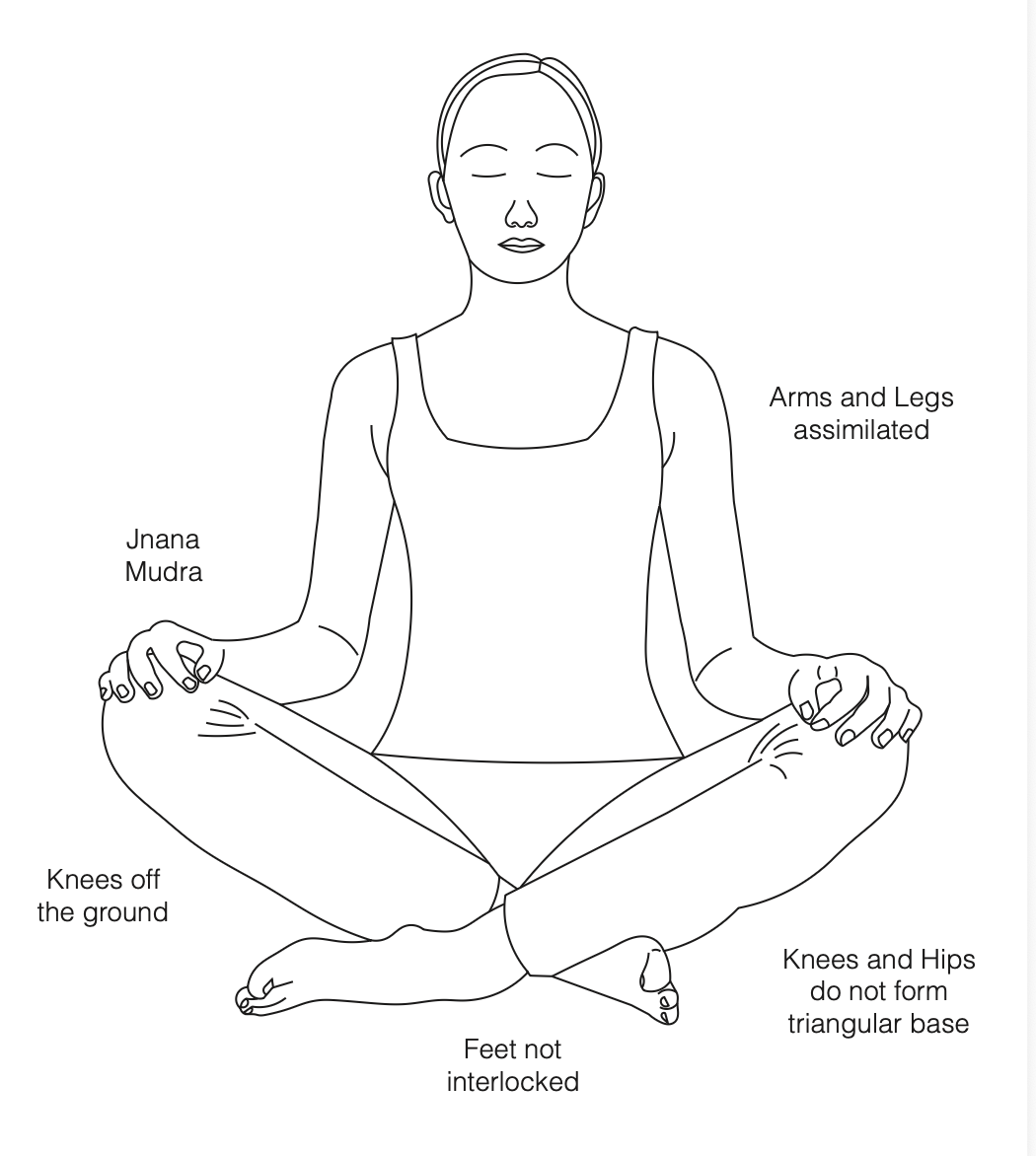
Sukhasana, the Easy Pose Credit: Mastering Pranayama by Radhika Shah Grouven
Sukha means “content” or “happy.”
In Sukhasana, head, neck and trunk are aligned, the hands are placed on the knees in Jnana Mudra and the legs are crossed. In Sukhasana each foot is placed on the floor under the opposite knee. If you have never sat cross legged before, then Sukhasana is a good posture to start with.
A lot of people who sit cross legged on the floor experience discomfort because the back is often not completely aligned. There is a strong tendency to slouch after a while; this causes a pain in the neck and lower back. The knees and hips do not form a firm base for the body to rest on, since the knees point upward. The weight of the body is unevenly distributed causing discomfort to the ankles. The posture is not stable since the body weight rests only on the buttocks. As you relax in this posture, the knees seem to get heavier due to the pull of gravity.
Sukhasana has an advantage over Maitri Asana, that is the legs are assimilated, but all the same you are not able to sit very comfortably with your head, neck and trunk perpendicular to the floor. You can sit on a cushion, but still better is to use layers of thin cotton or silk shawls. The advantage of thin shawls over thick blankets is that you can make a seat of thin layers. With time, as you will sit longer in this pose, you can remove one shawl after the other, until you have mastered the position; the shawls are only a temporary prop. Keep the shawls long and flat in a rectangular shape. Do not fold them into squares, this makes the seat bulky and uncomfortable. You do not need to purchase any expensive contraptions for sitting such as crescent cushions, stools or benches.
This is what you need to make a comfortable seat; experiment with these until you have mastered the posture:
1 thick woolen blanket (or sheepskin) for the base
1 silk shawl to cover the base blanket
6-7 thin cotton shawls for layers
4-5 additional cotton shawls to support knees (only if required)
1 thick woolen blanket or thick shawl to cover the body
You can now sit on the meditation seat you have made with layers of thin cotton shawls so that you do not slouch. The pose is more comfortable with layers of shawls but the knees are still not firm on the ground. The feet are pointing outward and are not entirely assimilated in this posture. There is also an unconscious tendency to come out of the cross legged position and stretch out the legs.
You can sit in Sukhasana for a while and when you find yourself tiring or the back starts hurting then move to the chair and continue doing your practices on the chair. This is recommended only if you are unable to sit comfortably in the cross-legged position over a longer period of time.
In Part 2/2 we will examine the classical postures for meditation and compare these to find the posture most suitable for you.